
What Is an AI-Native CRM and Why It Replaces the Classic CRM
 By Marceau· Kasar Team
An AI-native CRM is built around agents that capture interactions and update records on their own. Here is why it beats the classic CRM.
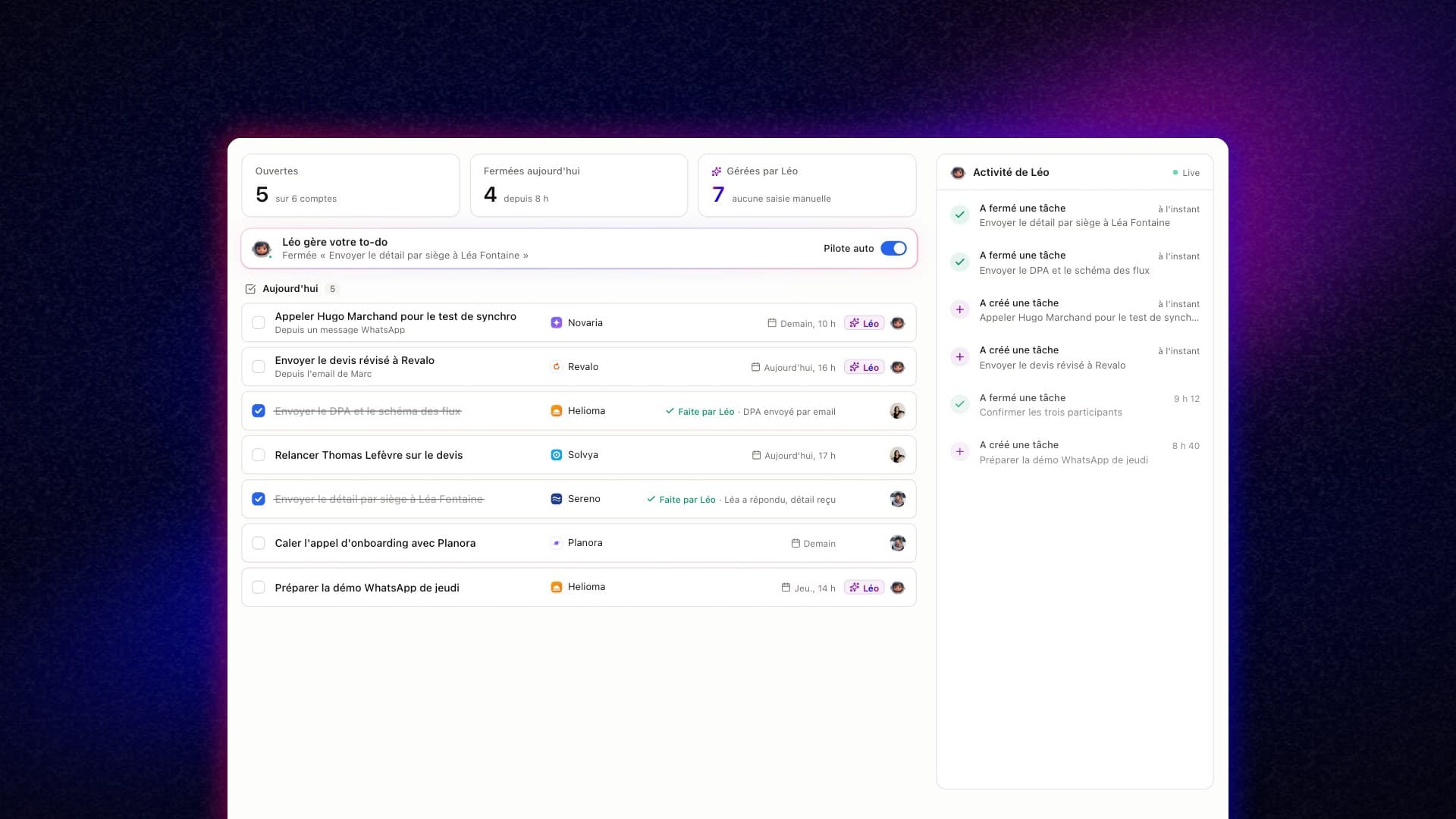
An AI-native CRM is a customer relationship management platform designed from the ground up around artificial intelligence agents. These agents capture every interaction, enrich contacts and update deal stages automatically, with no human data entry. The difference with a classic CRM is structural. In an AI-native CRM, the AI shares the same database, the same security model and the same workflow engine as the rest of the product. It does not merely suggest text. It takes action. This shift from suggestion to autonomous action is what makes the classic CRM obsolete for modern sales teams.
Definition: what is an AI-native CRM?
An AI-native CRM rests on three core properties. First, automatic capture: it logs emails, calls, LinkedIn and WhatsApp messages and meetings without any rep copy-pasting anything. Second, autonomy: an agent queries the CRM's live data and executes real actions such as creating a task, changing a status or drafting a follow-up. Third, deep integration: the AI is not a separate module. It lives inside the same system as contact records, the pipeline and automations.
This definition deliberately excludes a large share of products that market themselves as AI CRMs. A chatbot that summarizes a record or drafts an email is not an AI-native CRM. It is bolt-on AI.
AI-native vs bolt-on AI: the real difference
Most large players like Salesforce and HubSpot added AI on top of an architecture designed fifteen or twenty years ago. Salesforce Einstein and Agentforce run on infrastructure separate from the core CRM. HubSpot Breeze runs on a credit-based model whose cost becomes unpredictable at scale. In both cases, the AI stays a layer sitting on top. It sees the data but does not live in it.
The problem with bolt-on AI is synchronization and data quality. When the agent and the database do not share the same foundation, you reconcile constantly. Gartner even predicts that 40% of agentic AI projects will fail because of data quality. An AI-native CRM removes this integration tax: the agent writes directly into the data it reads.
What this changes in practice
- Suggestion vs action: bolt-on AI proposes a draft. The native agent updates the record and schedules the follow-up.
- Clean data by default: automatic capture replaces manual entry, the leading cause of poorly maintained CRMs.
- Cost and complexity: no surcharge billed per conversation and no connectors to maintain between two systems.
Why capture and autonomy are the real turning point
The classic CRM rests on a false assumption: that reps will fill in the tool. They do not. According to Gartner, sales teams spend up to 60% of their time on administrative work instead of selling. An empty or stale CRM is useless, no matter how powerful it is in theory.
An AI-native CRM flips the logic. The best CRM is the one that fills itself. Multi-channel capture feeds the database with no effort, and the agent turns that data into action. A 2025 Forrester study shows that natively integrated AI cuts time-to-insight by 67% and data reconciliation effort by 82% compared with bolt-on AI. The gain is not marginal. It is structural.
Leo, the agent at the heart of Kasar
At Kasar, the agent is named Leo. He is a teammate who works on everything the CRM captures: every interaction across email, LinkedIn, WhatsApp and calls. He prepares a brief before every meeting. He drafts follow-ups, updates fields and statuses when you ask, and enriches contacts. The rep no longer does data entry. The rep sells. That is exactly what our promise captures: sell more, type less.
Who benefits most?
The AI-native CRM benefits B2B sales teams, founders, SaaS companies and agencies first. These are the profiles juggling interactions across many channels with neither the time nor the appetite to feed a tool by hand. A flexible data model matters to them too: Kasar offers custom objects and more than 37 field types to fit any process.
Technical teams value the openness: Kasar exposes an MCP server and a REST API to plug the agent into the rest of the stack. On compliance, CASA Tier 2 certification and GDPR adherence meet the requirements of European buyers. The free trial runs 14 days, with no credit card required.
In short, the classic CRM asked humans to serve the software. The AI-native CRM does the opposite: the software works for the humans. As long as data entry stays manual, the data stays dirty and the AI stays a gimmick. Automatic capture and agent autonomy are the two conditions that make the AI-native CRM the natural successor to the classic CRM.
Frequently asked questions
An AI-native CRM is a customer relationship platform designed from the start around AI agents that capture interactions and update data automatically. The AI shares the same database, security model and workflow engine as the rest of the product. It takes action instead of only suggesting. Manual data entry disappears by design.
Salesforce and HubSpot add AI on top of an existing architecture: Einstein runs on separate infrastructure and Breeze uses a credit-based model. This bolt-on AI sees the data but does not live inside the CRM, which forces constant reconciliation. An AI-native CRM removes this integration tax because the agent writes directly into the data it reads.
Because a poorly maintained CRM is useless. According to Gartner, sales reps spend up to 60% of their time on administrative work instead of selling. Automatic capture across email, LinkedIn, WhatsApp and calls fills the database with no human effort and guarantees clean data, the necessary condition for AI to produce reliable actions.
Leo is the AI agent at the heart of Kasar, a teammate who works on everything the CRM captures. He prepares pre-meeting briefs, drafts follow-ups, enriches contacts and updates CRM fields and statuses when the rep asks.
Kasar is built for B2B sales teams, founders, SaaS companies and agencies that handle many multi-channel interactions. It offers a flexible data model with custom objects and more than 37 field types, an MCP server and a REST API, plus CASA Tier 2 and GDPR compliance. The free trial runs 14 days with no credit card.
Ready to let Leo fill your CRM?
14-day free trial. Sell more, type less.
Try Kasar for freeRead next
Leaving HubSpot: export, remap, carry the history over
A HubSpot export hands you columns and identifiers, in three datasets that do not leave through the same door. What decides a migration is not the export, it is the mapping table and the order in which you run it.
What your CRM never records: measuring your capture rate
The category has spent four years arguing from self-reported numbers that move twelve points between two editions of the same report. Capture rate works differently: one division, four conventions, computed on your own logs.